How Do You Promote Your Booth Before a Trade Show?
Spreadsheet
- Setup time: fast
- Cost: lowest
- Booth expenses: manual but flexible
- Travel: manual
- Staffing: custom entry
- Shipping: manual categorization
- Marketing: flexible
- Team usability: familiar, but inconsistent
- ROI reporting: mostly manual
Budget template
- Setup time: fast to moderate
- Cost: low
- Booth expenses: structured
- Travel: structured
- Staffing: clear planning fields
- Shipping: dedicated category
- Marketing: repeatable
- Team usability: simple and guided
- ROI reporting: basic
Expense software
- Setup time: moderate
- Cost: ongoing software cost may apply
- Booth expenses: strong
- Travel: strong automation potential
- Staffing: approval and reimbursement support
- Shipping: better receipt and transaction control
- Marketing: centralized tracking
- Team usability: requires training
- ROI reporting: primarily financial
Event ROI platform
- Setup time: moderate to long
- Cost: ongoing platform cost may apply
- Booth expenses: strong, often tied to outcomes
- Travel: usually requires connected data
- Staffing: useful when connected to event performance
- Shipping: helpful for cost-per-event analysis
- Marketing: connectable to campaign and lead results
- Team usability: requires process and data discipline
- ROI reporting: strongest for event performance
| Spreadsheet | Budget template | Expense software | Event ROI platform |
|---|---|---|---|
| Prioritizes easy transportation | Prioritizes reconfiguration | ||
| Typically lighter and more compact | Typically uses more substantial components | ||
| Often designed for smaller booth spaces | Can accommodate a wider range of booth sizes | ||
| Usually simpler and faster to assemble | May require more assembly or professional labor | ||
| Often travels in portable cases | May require larger cases, crates, or freight | ||
| Good when simplicity is the priority | Good when flexibility is the priority | ||
| Generally has fewer structural options | Can support more architectural and functional elements |
Promote your trade show booth by giving the right attendees a clear reason to visit, then repeating that invitation through a coordinated campaign before the event. Connect your message to a problem you can help solve, show people what they can experience in your booth, and make the next step easy. Your booth number tells them where you are. It does not tell them why they should care.
You have put time, money, and probably a few late nights into this show. Don’t leave the entire audience-development plan to whoever happens to walk down your aisle.
Pre-show promotion starts the conversation before your team arrives. Here’s how to make that conversation worth continuing.
Start with the people you want to meet
Decide who the invitation is for before deciding where to post it. Your current customers, active prospects, and people discovering your company may need different reasons to stop by.
A customer might want to see a new application of a product they already use. A prospect might need to compare solutions. Someone unfamiliar with your company needs to understand the problem you solve before a meeting sounds worthwhile.
Work with sales to identify the contacts and accounts that fit your show goals. Ask which conversations would move an existing relationship forward and which new audiences the team wants to reach. Use contact information and event-promotion options your company is authorized to use. An attendee list is not automatically yours to market to.
This gives your campaign a purpose beyond “get more people into the booth.” You want the right people arriving for reasons your team is prepared to address.
Give attendees a reason to make the trip
Lead with the value of the visit. A useful invitation answers three questions: What can I see or do? Why does it matter to me? What should I do next?
That reason might be a relevant demonstration, a chance to ask a specialist about a specific application, or a new product your audience has been waiting to evaluate. Choose something your booth can actually deliver.
For example, a hypothetical equipment supplier could invite operations managers to compare two changeover methods during a live demonstration. That is more useful than announcing, “We’re excited to exhibit!” The attendee can picture what they will learn.
Keep the promise specific and honest. Don’t advertise unlimited one-on-one consultations if one specialist is covering the booth between demonstrations. A great invitation that leads to a disappointing visit is an expensive way to lose trust.
Build a campaign instead of a last-minute announcement
Begin early enough to influence attendees’ plans, then give them relevant reminders as the show approaches. In my trade show tips, I recommend turning a three-day event into a broader campaign, with outreach beginning one to two months beforehand and continuing after the show. Treat that as a planning starting point, then adjust to your audience, event schedule, and available resources.
Your campaign can progress naturally:
- Introduce the reason to visit and the audience it will help.
- Show a useful preview, such as the problem your demonstration addresses.
- Invite a meeting when the conversation calls for dedicated time.
- Send a practical reminder with the booth location and what to expect.
Each message should add something useful. Repeating the same “Come see us!” graphic for six weeks is repetition, but it is barely a campaign.
If you are starting late, focus on one clear invitation and the channels where you already have relevant relationships. A simple, accurate campaign your team can deliver beats a complicated plan that never gets out the door.
Coordinate the channels your audience actually uses
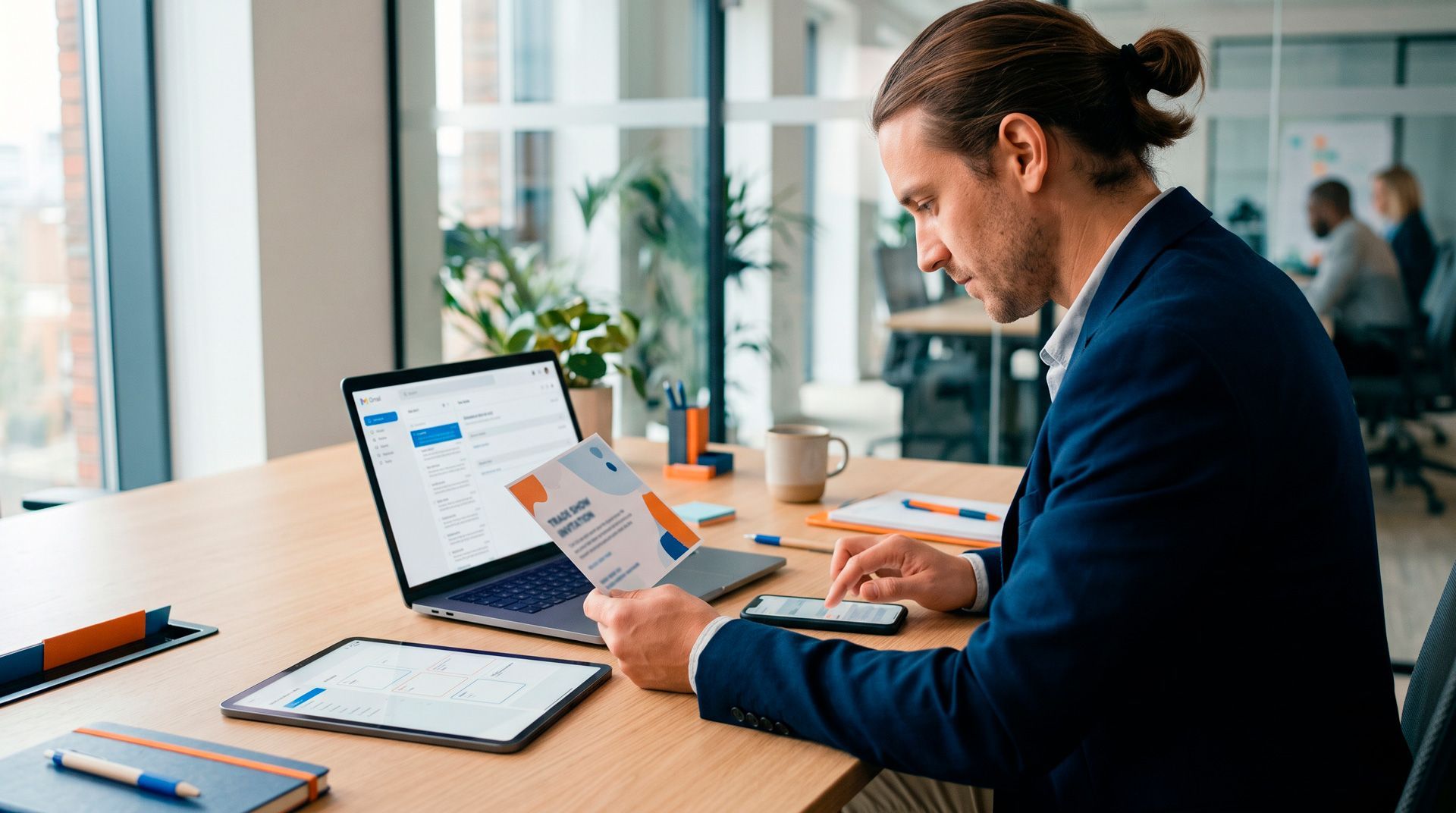
Use a mix of channels that fits your buyers and your capacity. Your website, email, relevant social channels, email signatures, and personal sales outreach can reinforce the same invitation without using identical copy everywhere.
Give each channel a job. Your website can hold the central event details. A salesperson’s message can explain why the visit matters to a particular account. A short video or photo can preview the demonstration. An email signature can keep the event visible during conversations already underway.
Check the organizer’s official exhibitor-promotion options, too. Depending on the event, those may include a directory profile, promotional assets, or an approved registration offer. Confirm availability, terms, and deadlines directly with the organizer before promising anything.
You do not need to be everywhere. You do need a consistent message, accurate details, and someone responsible for keeping them current.
Make the next step easy
Choose a next step that matches the invitation. A visitor interested in watching a demonstration may only need the booth number and schedule. Someone discussing a specific project may benefit from a scheduled conversation with the right person.
Include the event name, dates, booth location, and any relevant demonstration or availability details. If you invite people to book time, assign someone to manage the requests and confirm what your team can accommodate. Test the destination on a phone before sharing it.
Avoid making attendees work through several competing calls to action. If the message invites them to a demonstration, make that action obvious. Save the full product catalog for a conversation where it helps.

Prepare your booth team to deliver the promise
Your pre-show invitation and your booth experience should feel like parts of the same plan. Brief the team on what was promoted, who was invited, and what attendees may expect.
Make sure staff know how to welcome someone who mentions the campaign, where a promised demonstration happens, and who handles a specific account or technical question. Decide how they will record the visitor’s interest and agreed next step.
That connection is part of the Tradeshow Sandwich™: the work before, during, and after the show supports the complete experience. Promotion gets the conversation started. Your Lead Generators need to know how to carry it forward.
For practical preparation across that process, explore
Booth Boss Bootcamp.
Measure what the invitation produced
Choose measures that show whether your campaign reached the right people and led to useful activity. Depending on your goal, you might track meeting requests, confirmed appointments, campaign-referred booth visits, or relevant conversations that produced an agreed next step.
Use campaign links or a simple source field where practical, and ask staff to record when a visitor mentions an invitation. Those methods can provide useful signals without pretending every visit can be attributed perfectly.
Keep the stages separate. A click is not a booth visit. A visit is not automatically a qualified opportunity. Review what drew people in, whether the booth delivered what you promised, and what your team should repeat or change for the next show.
Start with one question: “Why would our intended attendee make time for us?” Build the invitation, campaign, and booth experience around a useful answer.
Frequently Asked Questions
Should you promote your booth if you do not have a new product?
Yes, you can promote a useful booth experience without launching a new product. Invite attendees to explore a relevant application, compare approaches, or ask questions about a problem your company already helps solve. Make the value specific to their needs.
Can a small team run an effective pre-show campaign?
Yes, a small team can run a focused campaign by using a clear invitation and a few channels it can manage consistently. Prioritize relevant customer and prospect outreach, keep event details in one reliable destination, and assign responsibility for responding to interest.
Should every pre-show invitation ask attendees to book a meeting?
No, the invitation should ask for the next step that fits the experience and the relationship. Offer meetings when dedicated time would help, and make it easy for other attendees to find a demonstration or stop by during exhibit hours.
Recent Posts