

How Do You Follow Up with Trade Show Leads?

Heather Bundgaard • October 15, 2026

Share this article

Follow up with trade show leads by delivering what you promised at the booth, contacting each person within the agreed timeframe, and giving them a relevant next step. Assign a clear owner to each lead, use your conversation notes to personalize the message, and coordinate marketing and sales so outreach stays useful and organized.


Your booth can attract attention, start great conversations, and generate promising leads. Follow-up is where your team carries those opportunities toward a sale. A stack of scans cannot do that work for you, no matter how impressive the number looks in your post-show report.


In the Tradeshow Sandwich™, post-show follow-up is the top layer. It holds together the work you did before and during the show. Here is how to make that part count.


Start the follow-up conversation in your booth

Before an attendee leaves, ask what they would like to happen next. Would a product comparison help? Do they want a demonstration? Should someone else join the conversation?


Then ask when they would like you to follow up. That question gives your team a real expectation to work toward instead of a deadline someone invents after the show.


Record the details you will need later:


  • The need, problem, or goal the attendee described.
  • The information or introduction you promised.
  • The next step they agreed to and their preferred timing.
  • Who on your team will take responsibility.


Be specific. “Send information about the product we demonstrated” gives your team a starting point. “Nice person. Good lead.” gives them a guessing game.

Give every lead a clear owner

Decide before the show who will enter contact information, check the notes, route leads, and handle personal outreach. Block out follow-up time before everyone’s calendar fills with the work waiting back at the office.


In one follow-up process I used, the booth boss brought the contacts back on the first business day after the show. Our receptionist entered them into the database. Marketing sent a thank-you email and distributed the leads to the appropriate sales reps, who were responsible for reaching out within 24–48 hours.


That was a process for that team, not a universal deadline. What mattered was that everyone knew their part. Adapt the responsibilities to your company and the timing you promised your attendees.


Keep the assigned owner and next action visible in the record your team uses. If a lead needs a technical specialist or a different sales rep, make the introduction and confirm who is taking over.


Prioritize the promises you made

Review your leads according to their needs, interest, and timing. Someone waiting on information for an active project needs different attention from someone gathering ideas for next year.


Work the urgent commitments first, including scheduled meetings and promised information. For a longer-term prospect, follow the timeframe you discussed rather than pushing for an immediate buying decision.


A general thank-you email can acknowledge the visit. A specific question, requested document, or agreed meeting still needs someone to handle it. Check that those promises have actually been completed.


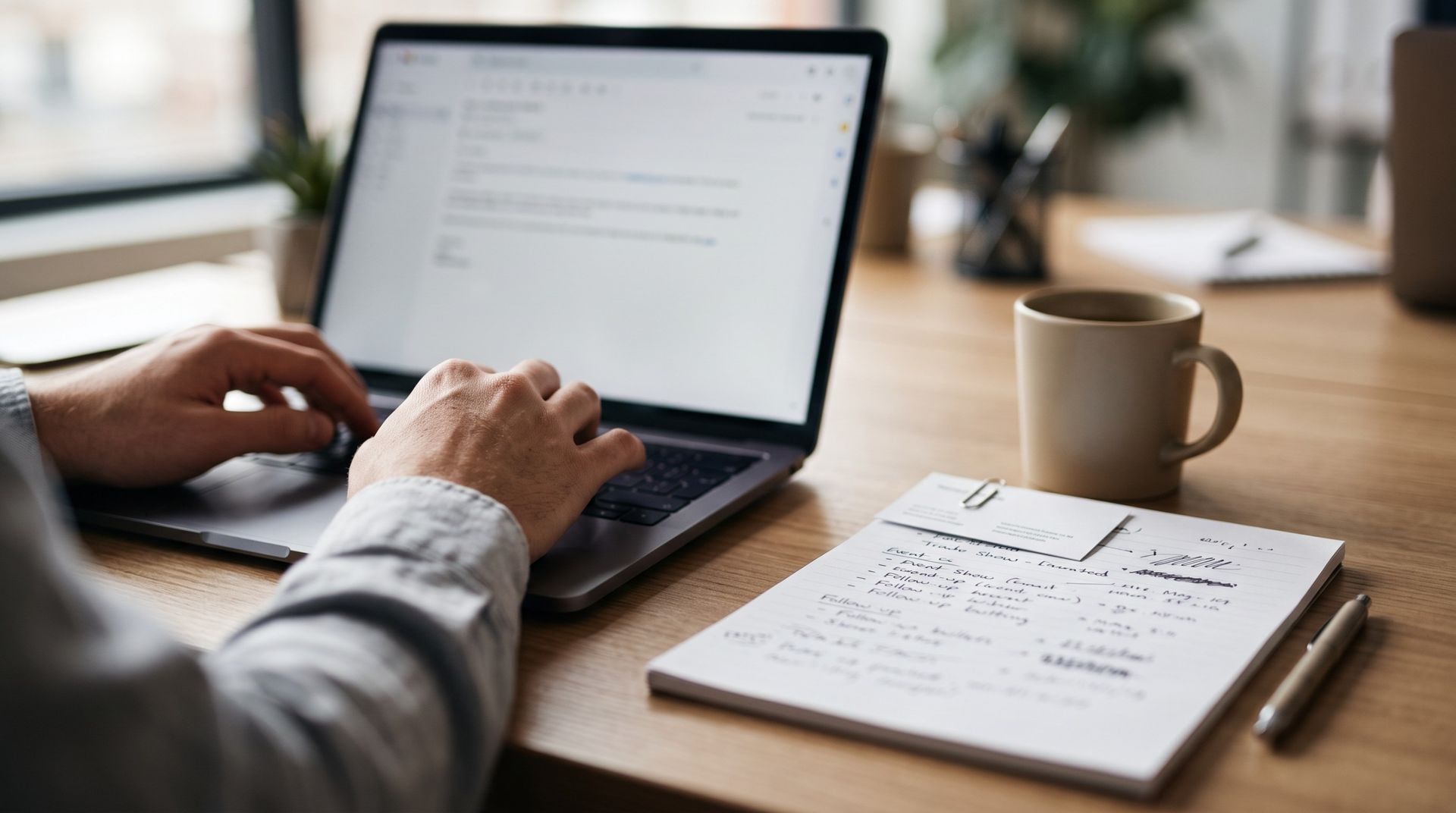
Writing a personalized trade show follow-up email using notes from a booth conversation

Make the first message worth opening

Your first follow-up should help the attendee remember your conversation and get what they asked for. Mention the show, connect your message to their situation, and make the next step easy to understand.


Keep it focused. They do not need your entire product catalog because they asked one question about one product.


Here is a simple email template you can adapt:


Subject: Your [topic] follow-up from [Show Name]


Hi [First Name],


It was good talking with you at [Show Name] about [specific need or project]. Here is the [information or resource] I promised.


You mentioned [relevant detail from your conversation]. Would [specific next step] be helpful? I can follow up [agreed timeframe], or you can let me know if your timing has changed.


[Your Name]


Replace every bracketed field with accurate information. If the attendee already agreed to a meeting, confirm that meeting instead of asking them to start the decision again. If you promised an answer you still need to research, acknowledge the request and tell them when you will provide it.


Coordinate personal outreach and ongoing marketing

Marketing and sales should be able to see what the other team has done. Otherwise, a prospect can receive a generic meeting invitation while already arranging that same meeting with a sales rep.


Record replies, completed calls, scheduled meetings, and promised next actions where the people handling the lead can find them. When a prospect responds, adjust the next communication to that response.


For contacts with a longer buying timeline, plan useful ways to stay in touch. Relevant product information, an answer to a question, or an educational resource can give them a reason to remember you. Match the outreach to their interests and your company’s communication rules.


In the process I described, ongoing marketing continued after the initial outreach. The first thank-you message was the beginning of the follow-up, not the entire plan.


Sales professional reviewing booth notes and business cards to follow up with trade show leads

Give later follow-ups a purpose

If someone does not respond, use their booth conversation to decide whether another message would help. Deliver a missing detail, answer a relevant question, or check whether the timing they mentioned still applies.


Repeatedly sending “just checking in” leaves the prospect to figure out why they should respond. Give them a clear reason to continue the conversation.


There is no single number of follow-up touches that fits every trade show lead. Build your approach around the interest they expressed, your sales cycle, and their replies. If they ask you to reconnect later, record when. If they decline further contact, respect that answer.

Track what happens after the message

Keep track of whether the promised information was delivered, the prospect replied, a meeting happened, or a useful next step was agreed. Sending an email completes a task; it does not establish that an opportunity has moved forward.


Review the leads still waiting for action and the ones needing a different approach. That gives you something concrete to discuss with sales and, eventually, with the person asking what the show produced.


Before your team closes out the event, check one thing: can the person responsible for each promising lead explain what was discussed, what was promised, and what happens next? If they cannot, that is the next piece of work to finish.


Frequently Asked Questions

  • Should every trade show lead receive the same follow-up email?

    No. Trade show follow-up should reflect the attendee’s needs, interest, and agreed next step. A shared template can save preparation time, but personalize the relevant details and deliver what you actually promised. Coordinate general marketing messages with any personal outreach already underway.

  • What should you do if your booth notes are incomplete?

    Ask the team member who spoke with the attendee to clarify the conversation before you send a personalized follow-up. If a detail cannot be confirmed, leave it as unknown and ask the attendee a straightforward question. Do not invent a need, deadline, or commitment to make the message sound personal.

  • Should you stop following up after the first unanswered message?

    Not necessarily. A relevant follow-up can be appropriate when the attendee expressed interest or requested information, but the next message should have a useful purpose. Consider their stated timing and any response you receive. Avoid an arbitrary sequence that ignores their requests or keeps repeating the same pitch.


Recent Posts

Booth staff member qualifying a trade show lead by listening to an attendee at a busy exhibit booth
By Heather Bundgaard • October 15, 2026
Learn how to qualify trade show leads with useful questions, customer-fit criteria, clear next steps, and notes your sales team can act on.

Team discussing charts and notes in a meeting room to choose an exhibit house for their trade show
By Heather Bundgaard • October 5, 2026
Learn how to choose an exhibit house, compare proposals, evaluate services, ask the right questions, and avoid costly trade show mistakes.
Exhibit house installation crew hanging a blue and orange graphic banner on a trade show booth frame
By Heather Bundgaard • October 5, 2026
Should you hire an exhibit house? Learn what exhibit houses do, when professional support makes sense, and how to weigh costs and benefits.
Side-by-side comparison of a portable and modular trade show exhibit in a convention center
By Heather Bundgaard • September 15, 2026
Learn the difference between a portable and modular trade show exhibit, and how to choose the right option for your booth strategy and budget.
Side-by-side comparison of a custom trade show booth with architectural accent lighting and a versat
By Heather Bundgaard • September 1, 2026
Compare custom vs. modular trade show booths. Discover key differences in cost, flexibility, and ROI to choose the best exhibit strategy for your brand.
Trade show booth with blue-and-white displays; two people assemble a frame while others browse in the background
By Heather Bundgaard • July 28, 2026
Compare renting vs. buying a trade show booth. Learn the pros, cons, costs, and key factors to choose the best option for your trade show strategy and budget.