What Is the Difference Between a Custom and Modular Trade Show Booth?
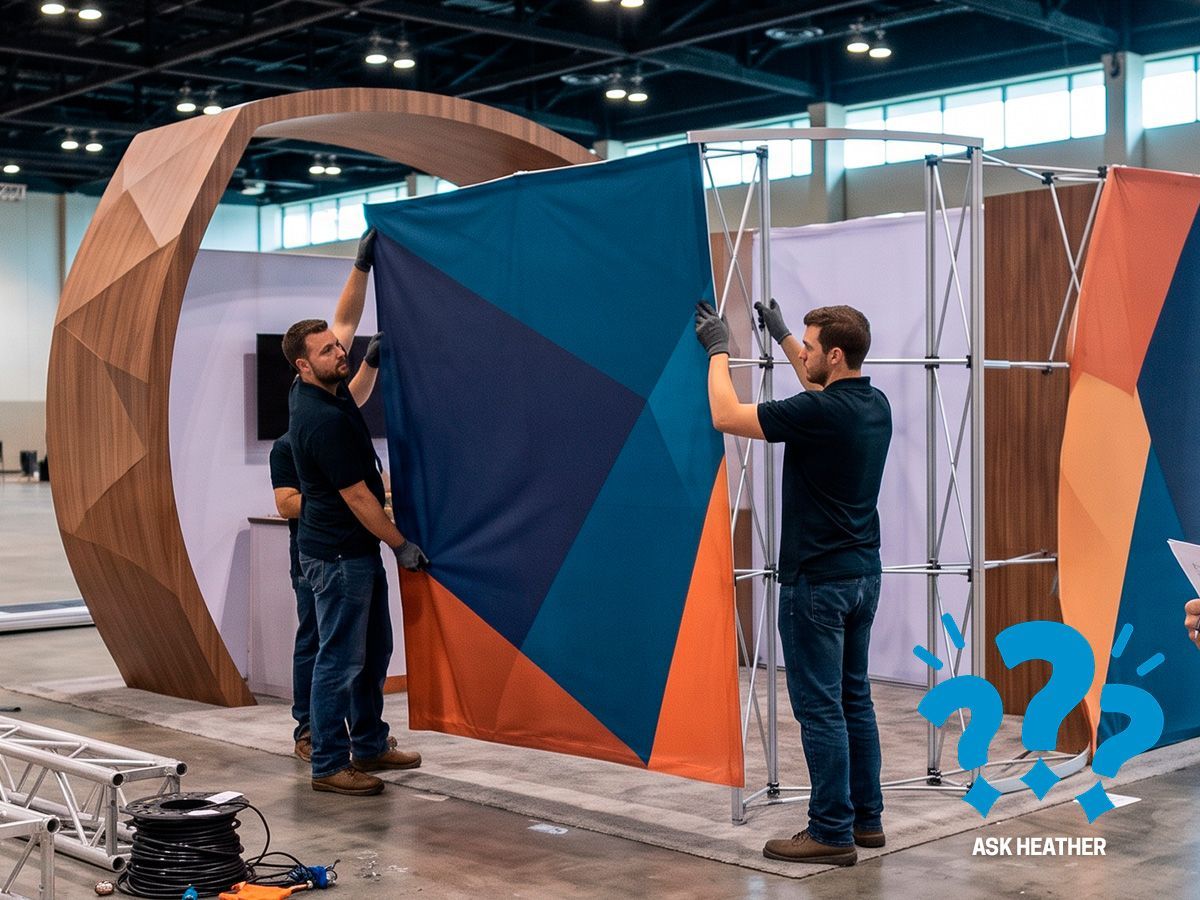
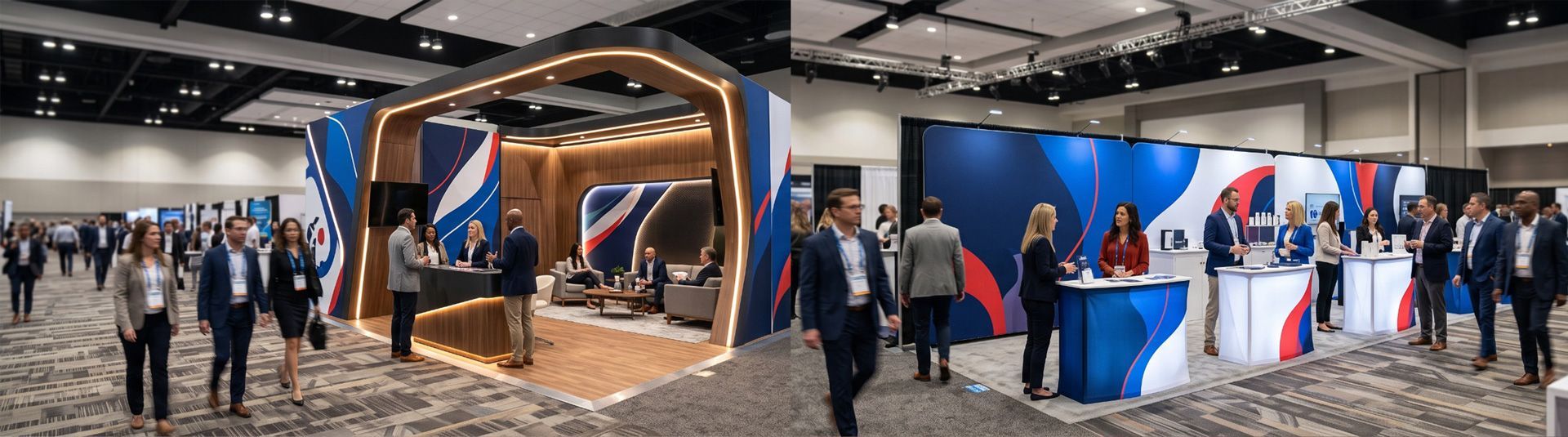
The biggest difference between a custom and modular trade show booth is how the booth is built and how much flexibility you have to change it. Modular booths use prefabricated, interchangeable components that can be assembled and reconfigured in different ways. Custom booths use components designed specifically around your brand, product, space, or experience. Custom usually gives you more design freedom and pizzazz, while modular usually gives you more flexibility, easier setup, and a more cost-conscious path.
But here’s the thing:
I would never tell you to automatically choose one over the other.
That would be like telling you to buy a minivan or a sports car without asking where you’re going.
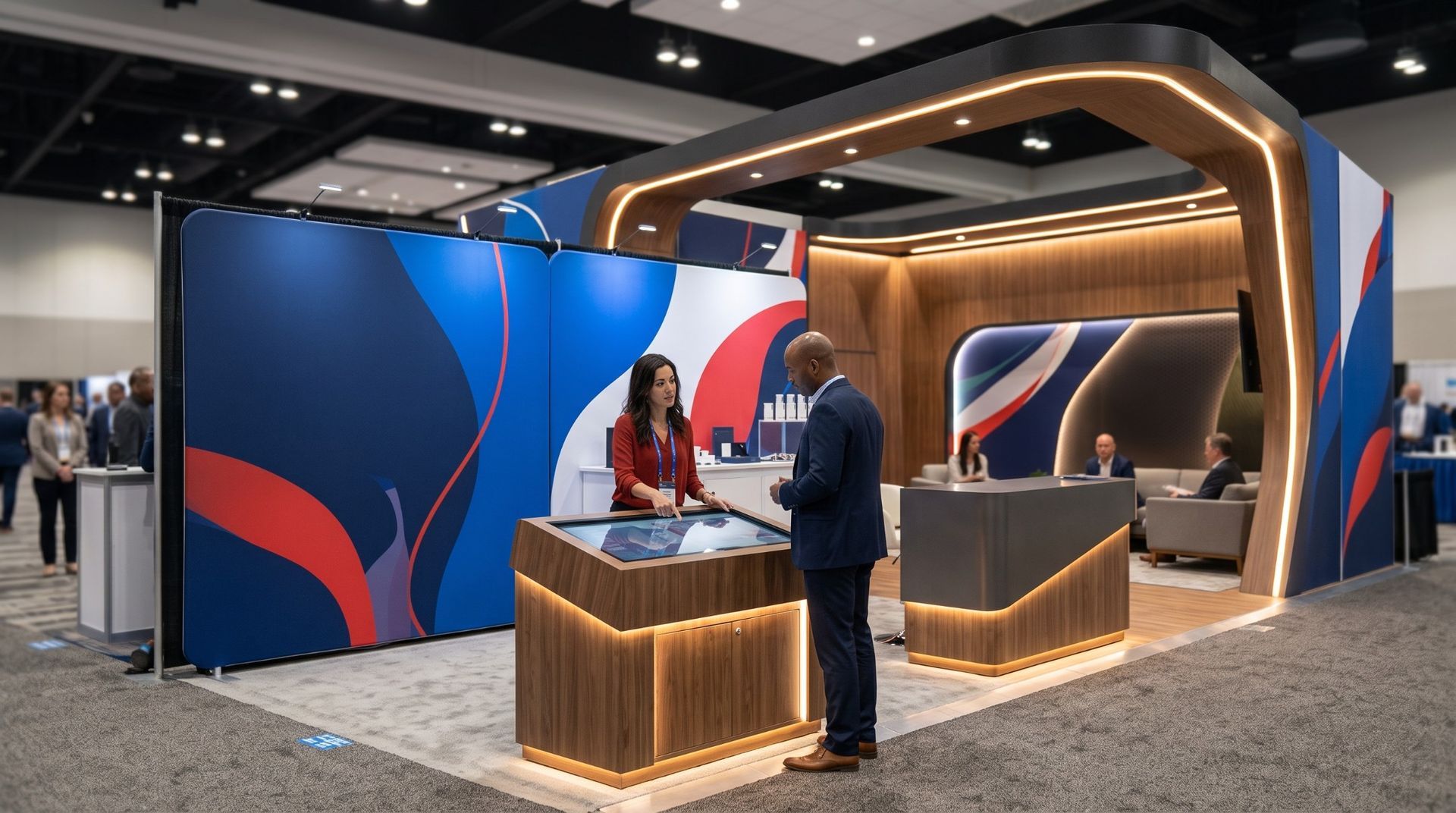
And yes, I am a marketing person through and through, so I can absolutely appreciate a gorgeous custom booth with all the bells and whistles. Give me an impressive LED wall, interesting architecture, clever lighting, and a product experience, and I get excited.
But my job isn't to get you excited about spending money.
My job is to make you look good to your boss. The last thing I want is for you to spend money on a booth that doesn't help you accomplish what you came to the show to accomplish. The goal isn't to build the most impressive booth you can afford. It's to invest in the booth that gives you the best opportunity to achieve your trade show objectives and generate a return on that investment.
And that means I need to ask a few questions first.
What should drive the decision between custom and modular?
Before we talk about booth construction, I want to know why you’re exhibiting in the first place and what you’re trying to accomplish.
Here are some of the first questions running through my head:
1. How many trade shows are you doing?
Frequency matters.
If you’re exhibiting three or more times a year with the same booth, modular starts looking pretty attractive. Modular components are designed to be assembled, disassembled, and reconfigured repeatedly without sacrificing the structure or stability of the frame.
Think of it like IKEA furniture versus a modular exhibit system.
If you kept taking the same IKEA table apart and putting the screws back into the same holes over and over, eventually those holes would be stripped.
Modular exhibit components are designed differently. They’re built for repeated use.
And if you’re going to put that booth through its paces several times a year, that matters.
2. What’s your budget?
Custom is generally more expensive.
And the purchase price isn't the only number you need to look at.
A larger or heavier custom booth can also mean higher shipping and material handling costs. Depending on what you're installing, your installation and dismantle costs can increase too.
For example, installing a 10-foot LED wall takes considerably more time and talent than installing a 10-foot pop-up back wall.
So don't just compare the price tag on the booth.
Look at the total cost of exhibiting with it.
That’s where things get interesting.
And if you're not sure you're ready to own a booth at all, it's worth asking whether it's
better to rent or buy a trade show booth before you start comparing construction styles.
3. What are you actually trying to accomplish?
This is the question I care about most.
- Are you launching a new product?
- Are you trying to make a major splash?
- Will your biggest competitors be right next to you?
- Are you trying to reposition your brand?
- Do you need to demonstrate a large or heavy product?
- Are you trying to generate leads, create brand awareness, or simply establish yourself in a new industry?
The answer to those questions should influence your booth design.
Because the goal isn't to own the coolest booth in the convention center.
The goal is to create a booth that helps you accomplish your business objectives.
When does a custom trade show booth make the most sense?
There are times when custom is absolutely worth considering.
Your product is high-end
If you sell a premium product, your booth probably shouldn't look like it came out of a catalog of generic displays.
Your booth is part of your brand experience.
If your product is sophisticated, expensive, or highly specialized, showing up with a cookie-cutter booth can create a disconnect between what you're selling and how you're presenting it.
You have a heavy product that needs engineered support
This is a big one.
Some products simply require a booth designed around them.
If you’re displaying heavy machinery, large equipment, or something that needs specialized structural support, custom engineering may be the right solution.
You’re new to the industry and need to stand out
Being the new kid on the block can make it harder to get noticed.
A thoughtful custom design can help you separate yourself from the sea of booths around you and give attendees a reason to stop.
But remember, custom doesn't automatically equal effective.
You still need a strategy for getting attention, engaging people, and turning that attention into qualified conversations.
You’re #1 in your industry
Here's where I'm going to be a little blunt.
If you're the recognized leader in your industry and you show up with a booth that looks like your kid made it in shop class, people may start making assumptions.
Your booth should support your position in the marketplace.
If your brand says, "We're the best," your exhibit shouldn't whisper, "We found this in the clearance aisle."
When is modular the smarter choice?
Modular can be a fantastic solution, especially for companies that are still figuring out their trade show program.
You’re new to trade shows
There is already a LOT to learn when you're new to exhibiting.
- Booth rules.
- Shipping.
- Material handling.
- Installation.
- Dismantle.
- Electrical.
- Lead capture.
- Staffing.
And about 900 other things nobody mentioned when your boss said, "Hey, can you handle the trade shows?"
A modular booth can reduce some of the complexity because it is generally easier to install and dismantle, and it can be more cost-effective than a larger custom design.
When you're new, reducing risk is not a bad thing.
You’re exhibiting three or more times a year
This is one of my favorite situations for modular.
If you’re going to use the booth repeatedly, you want materials that are designed to hold up through multiple installations and dismantles.
And depending on the system, modular components can also be reconfigured into different booth sizes.
That gives you room to grow.
A modular system might allow you to start with a 10x10 and eventually expand into a 10x20, 10x30, or 20x20 configuration.
That's pretty handy when your company is growing.
Cost is your number-one priority
If keeping the initial investment down is your primary concern, modular is generally the better place to start.
But please don't make the mistake of looking only at the initial booth price.
You still need to consider shipping, material handling, installation and dismantle, storage, graphics, and any additional components you'll need.
Saving money is smart.
Saving money in the wrong place is not.
You exhibit in different booth sizes
This is another big reason to consider modular.
If your company exhibits in a 10x10 at one show and a 20x20 at another, a flexible system can make life much easier.
You don't necessarily want to buy a completely different booth every time your footprint changes.
The biggest misconception about custom vs. modular
Here’s my favorite part:
You don't necessarily have to choose one or the other.
My favorite solution for a company that is growing beyond a basic pop-up booth is often a hybrid booth.
A hybrid approach combines modular components with custom elements.
Think of the modular portion as the foundation.
Then add the flair.
For example, you could use modular walls with high-end fabric graphics and then add custom components such as:
- 3D lettering
- Custom lighting
- Backlighting or edge lighting
- A unique reception counter
- Custom furniture
- Custom product displays
- Interactive elements
- Specialized branded architectural pieces
- Even custom finishes on the modular framework
One example I love is using a custom component to demonstrate the actual product.
I once worked on a booth for an outdoor composite decking company that wanted contractors and homeowners to see the different colors and types of decking they offered.
We created a layered, spinning display that allowed people to see how the different colors could be combined.
We also designed and manufactured a unique park bench using their composite boards.
It was seating, product demonstration, and brand experience all rolled into one.
And later, the company used those benches in its office lobby.
Fun, right?
That's the beauty of hybrid.
You can start with a modular foundation and add custom pieces over time as your budget, brand, and trade show program grow.
Don't strip away the things that get people into your booth
This is one of the mistakes I see companies make when they're trying to save money.
A marketing director may be new to the company and want to put their best foot forward by cutting costs.
That's admirable.
But sometimes they cut away the exact things that were going to get people to stop.
And that's a problem.
Because saving money isn't really saving money if you're removing the things that help your booth do its job.
If a particular lighting element, product display, interactive experience, architectural feature, or graphic is helping your booth stand out and encouraging people to enter, don't automatically remove it because it costs more.
The name of the game is to get people into the booth so you can have more conversations, generate more qualified leads, create more opportunities to close business, and learn more about your audience along the way.
Knowing where to save and where to splurge comes with experience. The goal isn't simply to spend less. It's to know which investments are helping you accomplish what you came to the show to accomplish.
That's a much better conversation to have with your boss than, “Good news! We spent less.”
So, which one should you choose?
Before you decide, ask yourself these five questions:
- How many trade shows will this booth be used for each year?
- What is my realistic total budget, including shipping and show services?
- What am I trying to accomplish at these shows?
- Will I need different booth sizes or configurations?
- What does my product and brand require to look credible and stand out?
If you're exhibiting frequently, need flexibility, want to control costs, or expect your booth size to change, modular may be the smarter foundation.
If your product is high-end, heavy, highly specialized, or your brand needs a more distinctive presence, custom may make more sense.
And if you're somewhere in the middle?
Don't be afraid to go hybrid.
You don't have to build the Taj Mahal just because you have a booth.
And you don't have to strip your booth down to the bare walls just to save a few dollars.
The right booth is the one that solves your problem, supports your goals, represents your brand, and gives you the best opportunity to generate a return on your investment.
Because at the end of the day, I don't want you to tell your boss, "Look how beautiful our booth is."
I want you to be able to say:
"Look what our booth helped us accomplish."
Frequently Asked Questions
What is the core difference between a custom and a modular booth?
Construction and adaptability. Modular booths rely on standardized, interchangeable components that can be easily reconfigured or scaled for different spaces. Custom booths are engineered from scratch to match a specific design, brand aesthetic, or unique structural requirement.
Which option is more cost-effective?
Modular is generally more budget-friendly across the board. Beyond the lower upfront build cost, modular systems significantly reduce shipping weight, material handling fees (drayage), and installation/dismantle (I&D) labor.
When should I choose a modular booth?
Choose modular if you exhibit frequently (3+ shows a year), need to adapt to varying footprint sizes (e.g., 10x10 at one expo, 20x20 at another), want faster setup times, or are working with strict budget limits.
When is a custom booth necessary?
Invest in custom when you need to support heavy machinery/products, are showcasing high-end luxury items where unique architecture is critical, need to establish instant market leadership, or require specialized experiential zones.
What is a hybrid booth?
A hybrid approach combines a modular structural foundation (like tension-fabric walls) with custom-built focal points (like 3D dimensional lettering, custom reception counters, unique demo tables, or integrated lighting). It offers the cost and logistics benefits of modular systems alongside the high-impact visual appeal of custom design.
Recent Posts